Recent Posts

Wednesday, 7 December 2016

Broadway Limited 3234, N-Scale EMD E7A diesel engine

I love traveling. And I really appreciate the fact that my job requires me to visit different places from time to time. It's pure fun unless the journey is almost as long as the stay. Then it's good to plan something extra to sweeten the deal. On my recent trip my reward was a new American locomotive.

It's a diesel engine, and it's made by Broadway Limited - a company I had no experience with before. It's an N-scale model of a popular (in the United States) EMD E7A locomotive. It is DCC-equipped, and features many sound functions. I've bought it on-line from the well-known ModelTrainStuff store and it arrived in a surprisingly impressive plastic box.


The box is really big (for an N-scale product, that is). It could easily fit three or maybe even four such locomotives. But it also makes you feel like you're buying a premium product and actually provides a nice unboxing experience. Not to mention that the model seems to be really well protected with the thick layer of foam around it.


Here's the model itself. Removed from the transparent plastic wrap and awaiting its first inspection.


The very first look at the engine in a strong light reveals a nasty surprise. The locomotive came in dirty which is well visible in the photo below. Those look like some oil stains. And the plastic wrap feels a little sticky, too. Well, I guess I just have to clean it then...


The remaining content of the package consists of:
  • 24 pages long Operator's Manual
  • Assembly/disassembly diagram
  • Registration card (extending the warranty to 2 years, and this offer does not seem to be limited to US citizens only)
  • Alternative parts for the model
  • Small desiccant bag


The Operator's Manual is pretty comprehensive. It covers DCC operation in great detail and - given the complexity of some of the functions - is actually an interesting and useful read.
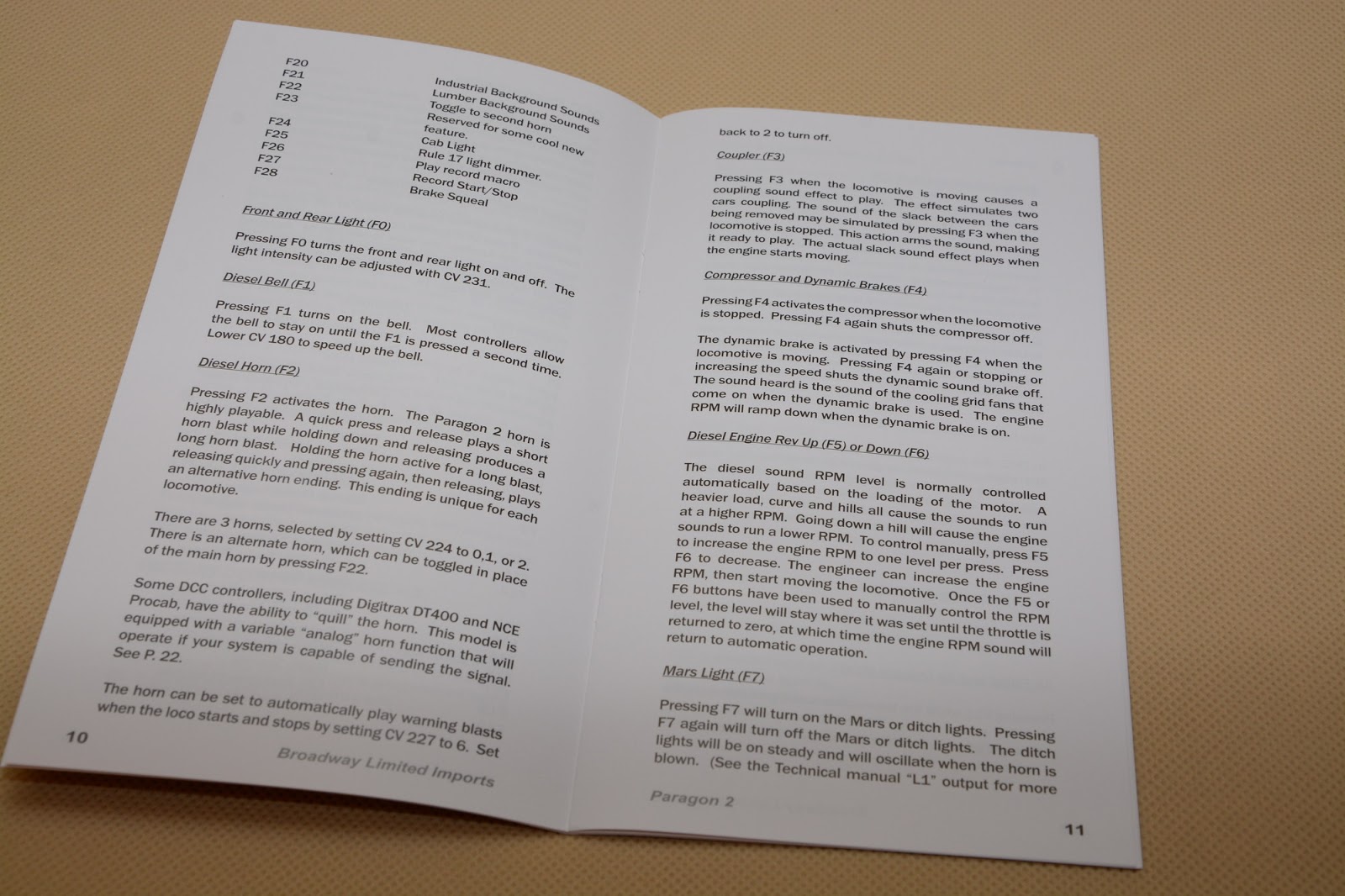

The replacement parts allow modification of the model's front look. In particular, one can get rid of the front coupler and replace it with a seamless pilot. That's a great idea considering how unusual this locomotive would look like pulling cars and going backwards at the same time.


Alright, it's time to take a look at the model. The first impression is very good. The engine is heavy and does not feel fragile. Except for a few small details it makes an impression of a sturdy piece. I'm not going to test it, but it does not feel like it would break easily...


It looks pretty nice, too. It's not extremely detailed but it does have quite a few handrails here and there. These are made of metal unlike the horns on the top which are purely plastic. The "door part" at the back is not fixed and can be moved a little. At first I thought it was broken but it seems it's really meant to be this way. Nice!

The engine is painted with rather discreet colors. I'm not a fan of such a soft look but it does make it appear more realistic. And the paint job is done very well overall. I like the "Wabash" flag at the front of the locomotive very much. Great detail!

Let's enjoy some more photos then...


So how does it run? In my short tests it performed very well. It ran nicely at low speed, and very well at high speed, too. It does get a little bit loud at maximum velocity but it's unnaturally fast then, too, so it's a scenario nobody will ever use. It rode smoothly, did not get stuck even once and did not derail.

Let's talk about the DCC functions. This model features over two dozens of those. Seems like every new DCC locomotive I buy is even more advanced than my previous one. So what's new here?

We get a lot of sounds. Horns, bells, couplers, brakes and many, many spoken dialogues. There's a lot to choose from and some of them even happen to play out at random during regular operation.

Talking about "random" - this engine really feels alive. It rarely produces just the engine noise and seems to feature a complex logic allowing it to make the experience more interesting by generating effects by itself. This is very nice but also a little complicated. The manual helps here a lot but... I still failed to force the engine to produce a brake squeal sound automatically when slowing down.

Last but not least - the locomotive's decoder allows recording "macros" which can later be replayed. Unfortunately I was not able to test this functionality. Using Roco Multimaus controller I am able to access only functions from 1 to 20. And the macro recording feature can be found at number 26.

But luckily there's still a lot to enjoy even with a limited controller. Here's a demo of some of the model's functions:


Summary

Having spent a day with my new purchase, I don't regret buying it at all. It performs very nicely, offers a lot of functionality and obviously is much cheaper than similar models from the European manufacturers. It does not look extremely detailed but the full-scale original is not very complex either.

I definitely love the product as a set taking into account the comprehensive manual and the alternative parts. Better than usual "unboxing experience" made me feel like I bought something special. I hope the time shows that the feeling was justified.

Monday, 21 November 2016

Bachmann 93433, G-Scale Tidewater tank car

While purchasing my last batch of N-scale wagons at the Hattons online store, I've also noticed they carried some G-scale products. I was not aware of that fact before and was even more surprised when I noticed some real bargains on their offer. One of the items that caught my interest was an American tank car from the Bachmann Big Haulers line.

The model looked nice and shiny and at a very attractive price of 43 British pounds I could not let it pass. I've ordered it and a few days later it arrived at my door. Packaged in the standard red Bachmann box it looked very promising at first sight.


Let's take a look inside. Unboxing the product reveals a standard G-scale packaging. Polystyrene foam protects the model from any damage. The car arrived intact.


The content of the box is not very rich. We only get the tank car itself and a set of replacement couplers.


By default American knuckle couplers are installed on the model.


A set of LGB-style couplers is included for users who need them. A manual is provided to explain the installation process but any modeller should be able to do this without even looking at the diagram.


I don't use knuckle couplers on my G-scale models at all. So exchanging them was the first thing I've done.


The model (almost) fits into the box with the longer hook-and-loop couplers.


Since the set did not include an additional elements to describe, let's just take a look at the tank car itself.


It's difficult not to like the model. It has a very reasonable amount of details, including several handrails, ladders, platforms and a well-modeled dome. I like the silver painting with the smooth and shiny look which makes the red text labels stand out nicely.

The main handrail surrounding the top area of the car is made of metal which is a nice surprise. Wheels are of course steel and that seems to be a pattern on all Bachmann products. The underframe is nicely detailed, although I have to admit it's just the "usual American type" without any special touch.

For the most part the car feels like a quality product. Unfortunately it seems the tank element is not made of the best possible plastic material. This results in its surface not being perfectly round and reveals a few defects where one would expect a perfect finishing. That particular part does feel cheap which is a small disappointment.

With the metal wheels the car has a decent weight and rides nicely on the track. The couplers attach perfectly to other rolling stock pieces and provide a reliable connection.

Summary

Considering its price, buying the car was a very good deal. I really like the way it looks and I'm happy with the model overall. The usage of cheap plastic for the tank element is a disappointment but it does not destroy the fun and hopefully will not affect model's longevity. The small defects in the details I found prove it's a rather budget product, but it was cheap after all. The car is not bad by any means but it could be making a slightly better impression. Is it good enough for you? You'll have to decide yourself.

Tuesday, 8 November 2016

Engineer installation inside LGB electric locomotive

The LGB 20755 electric locomotive is an item I've bought some months ago. My full review of the product can be found here. The engine performed very well throughout the season and I'm very happy with it so far. One thing it was missing right from the start was a train driver figure. Instead the model had just an empty cab.

I visited San Francisco around the same time and experienced the last model store in the city going out of business. There was a huge sale and one of the items still on the shelves was a G-Scale engineer from Bachmann. At 80% off it was a real opportunity and I had to buy it. Its catalog number was 92331.

Around 6 months have passed since those purchases were made. I've decided it was time to finally install the figure inside the engine model.

LGB 20755, Bachmann 92331
Let's take a closer look at the train driver model first. It's a simple sitting figure without any painted details on its face. A nice feature are the movable arms but I'm surprised the body of the model somehow leans to the left. Still, looks like it should fit nicely...


I'm opening the locomotive for the first time. I don't want to do any damage, so I'm placing a piece of foam under it. It should ensure that no details are damaged in the process.


Opening the model is easy... once you know how to do it. There are 10 screws holding the bottom and the top parts together. These are well hidden and I had to use a flashlight to find them.

Once unscrewed it opens almost by itself. Now we can see the interior of the model.


The cab element is found inside the top part. It's held by some plastic latches but comes out without using much force.


I always felt the headlights on this locomotive were not really that bright. And here's why. There's only one LED acting as the source for all three lamps. A diffuser part is supposed do distribute the light. No wonder it seems weak, with the top headlight appearing as the weakest.


Let's go back to installing the train driver. Hmm... he seems a little too large.


There's no way its legs can fit in. The compartment is simply not spacious enough. The only achievable position is when the engineer does not look like he cares about the fate of the train at all.


Desperate times require desperate measures. Legs off!


Much better now. I've used my favorite hot glue gun to attach the pieces together. It should hold well enough. And in case it falls off - no big deal, as I already know how to open my locomotive and can quickly fix it.


Closing the model was easy and... I've managed to fit all the parts coming from the earlier disassembly. So the locomotive is most likely still in full working order and the new driver will ensure the train always arrives on time :)